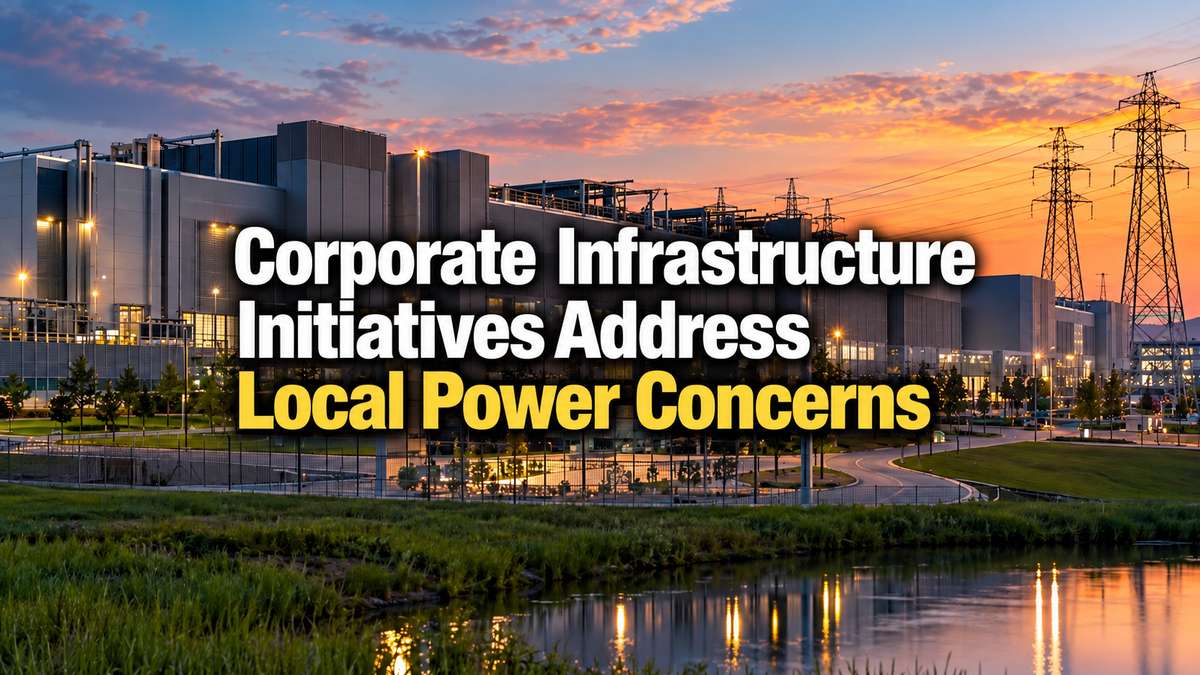
Corporate infrastructure initiatives are increasingly being designed around a challenge that extends well beyond construction: convincing local communities that rapid expansion will not overwhelm power grids, raise household costs, or undermine regional development priorities.
Across the United States, large technology facilities, advanced manufacturing plants, warehouses and other energy-intensive projects are creating new pressure on electricity systems. The issue has become particularly significant as artificial intelligence and cloud computing accelerate demand for large-scale data centers. For companies pursuing expansion, securing land and regulatory approval is no longer enough. Community confidence in how new infrastructure will affect electricity supply has become a critical part of the development process.
Developers have responded by emphasizing investments intended to reduce the burden placed on existing utility systems. Those measures can include new substations, transmission improvements, dedicated generation capacity, battery storage, renewable-energy procurement and efficiency technologies. In some regions, companies are also working with utilities to determine how the costs of infrastructure upgrades should be allocated.
The central concern for residents is straightforward. A major industrial or computing facility can consume enormous amounts of electricity, and communities want assurances that accommodating that demand will not compromise grid reliability or force ordinary customers to subsidize costly upgrades.
The debate is increasingly shifting from whether communities should welcome economic investment to who should pay for the infrastructure required to support it.
That question is especially important in regions experiencing simultaneous population growth and corporate expansion. Utilities must plan years ahead for new generation and transmission capacity while attempting to predict electricity demand that is evolving unusually quickly. Projects tied to artificial intelligence can further complicate forecasts because their potential power requirements may be considerably larger than those of conventional commercial developments.
Corporate strategies therefore increasingly include direct engagement with local governments, utilities and residents. Companies are highlighting construction employment, permanent jobs, tax revenue and infrastructure improvements while attempting to demonstrate that their facilities can operate without destabilizing local electricity systems.
Yet economic benefits do not automatically resolve public concerns. Residents may question whether promised jobs justify additional transmission lines, industrial construction, water consumption or changes to surrounding land. Electricity prices are particularly sensitive because even the perception that households could bear costs associated with corporate expansion can generate political resistance.
For developers, the consequences are substantial. Grid access and community acceptance are becoming strategic constraints on where major infrastructure projects can realistically be built. A location offering inexpensive land and favorable taxes may lose its advantage if electricity capacity is insufficient or local opposition delays development.
This dynamic is likely to reshape corporate site selection. Companies may increasingly favor regions where utilities can provide clear timelines for new power connections, regulators have established rules for allocating infrastructure costs, and communities receive tangible economic benefits from development.
The broader transformation also presents an opportunity. Large corporate electricity demand can help justify investments in transmission, generation and storage that might otherwise take longer to develop. If structured effectively, those investments could strengthen regional grids while supporting new industries.
But the political bargain will remain demanding. Communities increasingly expect companies to demonstrate not simply what they intend to build, but how they will pay for the energy infrastructure their expansion requires and what residents will receive in return.
As electricity demand becomes a defining factor in America’s next wave of industrial and technological growth, successful corporate expansion will depend on more than capital and engineering. It will depend on proving that economic development and reliable, affordable power can advance together.
Leave a Reply