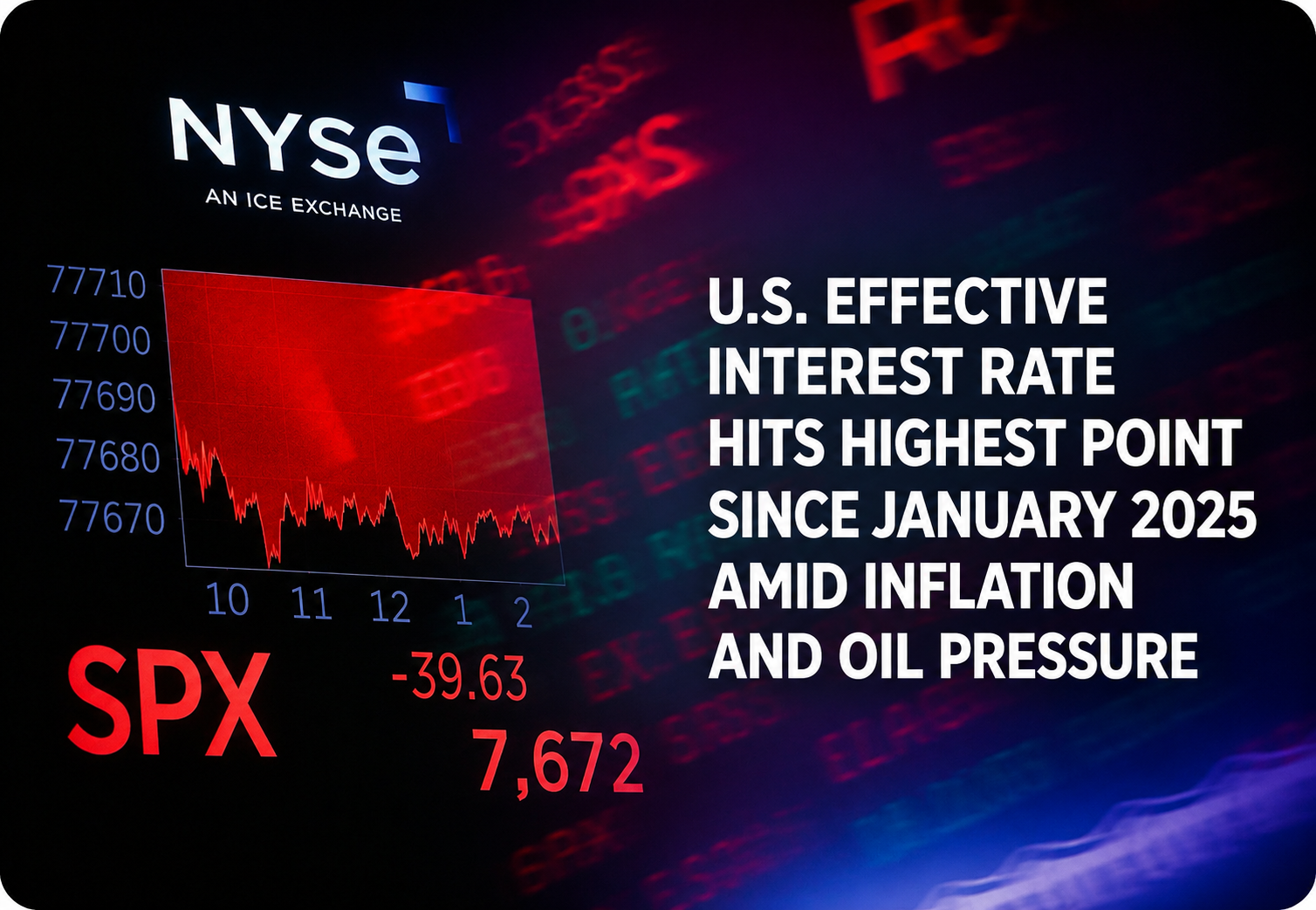
U.S. Effective Interest Rate Hits Highest Point Since January 2025 Amid Inflation and Oil Pressure
U.S. borrowing costs are climbing sharply as investors confront a renewed combination of inflation pressure, rising energy prices and expectations that the Federal Reserve may need to keep monetary policy tighter for longer.
As of September 2, 2026, the benchmark 10-year U.S. Treasury yield has moved to around 4.8%, reaching its highest level since January 2025. The move represents a significant shift in financial conditions and is being closely watched across Wall Street because Treasury yields influence borrowing costs throughout the U.S. economy.
The rise has accelerated as crude oil prices climbed above $90 per barrel amid renewed geopolitical tensions in the Middle East. Higher energy prices can quickly filter through transportation, manufacturing and consumer costs, raising concerns that inflation could remain stubbornly above the Federal Reserve’s long-term 2% target.
Inflation expectations are once again becoming a major force in the bond market. When investors expect prices to rise faster, they typically demand higher yields to compensate for the declining purchasing power of future interest payments. That pressure has contributed to selling across government bonds, pushing yields higher.
Shorter-term Treasury yields have also risen. The two-year Treasury yield, which is particularly sensitive to expectations for Federal Reserve policy, has moved above 4.3%. Meanwhile, longer-term borrowing costs remain elevated, reflecting concerns not only about inflation but also about government financing requirements and the large supply of Treasury securities entering the market.
The Federal Reserve has maintained its benchmark target range at 3.50% to 3.75%, with the effective federal funds rate recently around 3.63%. However, markets are increasingly focused on whether policymakers could raise rates again rather than deliver the easing investors had previously anticipated.
The combination of expensive oil, persistent inflation and rising Treasury yields is changing the outlook for American consumers and businesses.
Higher Treasury yields can influence mortgage rates, auto financing, corporate loans and other forms of credit. For prospective homebuyers, elevated long-term yields could make affordability more difficult if mortgage rates remain high. Businesses may also face higher financing costs when issuing debt or borrowing for expansion.
Financial markets are feeling the pressure as well. Higher risk-free Treasury yields can make government bonds more attractive relative to stocks, particularly companies whose valuations depend heavily on future earnings. Technology and other growth-oriented sectors can therefore become more sensitive when long-term yields rise rapidly.
At the same time, higher rates can benefit savers by supporting stronger returns on certain savings accounts, money-market products and newly issued fixed-income securities.
Oil remains one of the most important variables to watch. A sustained increase in energy prices could reinforce inflation across the economy and complicate the Federal Reserve’s efforts to bring price growth under control.
The central question now is whether the latest surge in yields represents a temporary reaction to geopolitical and energy-market pressure or the beginning of a longer period of elevated U.S. interest rates.
Upcoming inflation, employment and economic-growth data will play an important role in determining the Federal Reserve’s next move. If inflation remains persistent and energy costs stay elevated, policymakers could have less flexibility to lower rates—and markets may have to adjust to higher borrowing costs for longer.
For households, businesses and investors, the message from the bond market is becoming increasingly clear: the era of rapidly falling U.S. interest rates may be further away than many had expected.
Leave a Reply