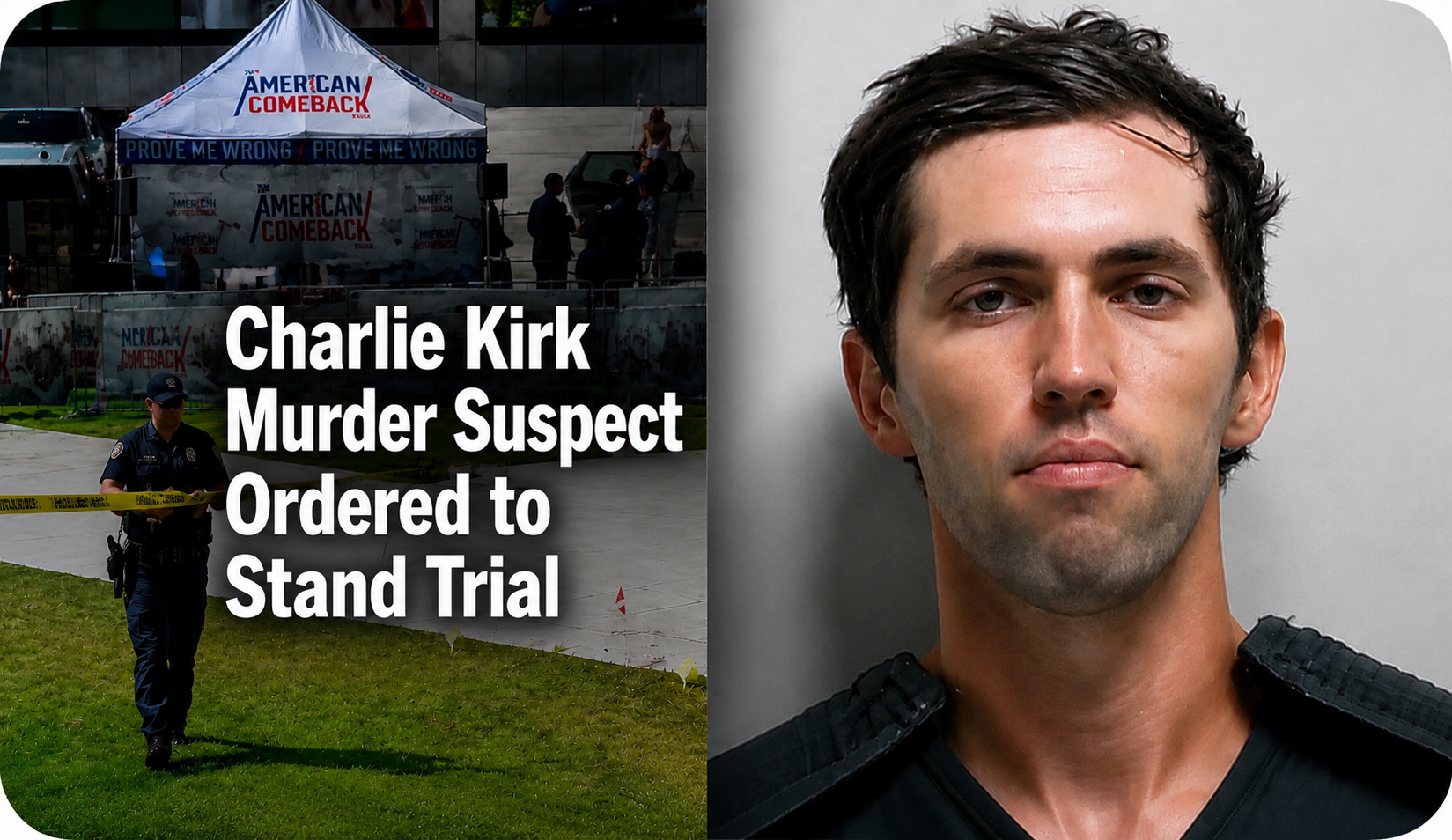
A Utah judge has ruled that Tyler James Robinson, the 23-year-old accused of killing conservative activist Charlie Kirk, must stand trial on an aggravated murder charge, allowing prosecutors to continue pursuing the death penalty in one of the nation’s most closely watched criminal cases.
Fourth District Court Judge Tony Graf issued the ruling in Provo, Utah, after hearing final arguments from prosecutors and defense attorneys. The decision means the case has cleared a critical preliminary stage and will now proceed toward trial.
The ruling does not determine Robinson’s guilt. Instead, the judge found that prosecutors presented sufficient probable cause for the charges to be decided at trial.
Robinson is accused of fatally shooting Kirk on September 10, 2025, while Kirk was speaking at an outdoor event at Utah Valley University in Orem, Utah. Kirk, 31, was the co-founder of Turning Point USA and had become one of the country’s most recognizable conservative political activists.
According to prosecutors, a single rifle shot was fired from the rooftop of a building roughly 415 feet from where Kirk was speaking. Thousands of people were attending the event.
Robinson faces aggravated murder, a capital felony, along with additional charges including felony discharge of a firearm causing serious bodily injury, obstruction of justice, witness tampering and committing a violent offense in the presence of a child.
Judge Graf ruled that probable cause exists for Robinson to stand trial on all charges.
A central issue in the preliminary proceedings was whether the circumstances surrounding the shooting were serious enough to support the aggravating factor that could make Robinson eligible for the death penalty.
Prosecutors argued that firing a high-powered rifle toward an event attended by thousands created a substantial danger to people beyond the intended target. They maintained that individuals near Kirk and others potentially within the rifle’s line of fire faced a risk of death.
The defense challenged that argument, emphasizing that only one shot was fired and questioning whether the evidence established that the shooter knowingly created a significant risk of killing another person.
Judge Graf ultimately determined that the prosecution had presented enough evidence at this stage for the aggravating circumstance to remain part of the case.
That decision is particularly significant because Utah County prosecutors have announced their intention to seek the death penalty.
During the preliminary proceedings, prosecutors outlined evidence they say connects Robinson to the shooting. The evidence presented included surveillance and security video, DNA evidence associated with the suspected murder weapon, electronic communications and statements prosecutors say indicate Robinson admitted responsibility.
Prosecutors also presented evidence they say shows Robinson moving around the Utah Valley University campus and reaching the rooftop area connected to the shooting.
Defense attorneys have challenged important portions of the prosecution’s case, including the reliability and interpretation of some evidence. They have also questioned the state’s use of hearsay evidence and disputed whether prosecutors established the required elements of aggravated murder.
Those disputes will become increasingly important at trial, where prosecutors will face a much higher burden than they did during the preliminary hearing.
At the preliminary stage, the judge was deciding whether sufficient evidence existed to move the case forward—not whether the prosecution had proved Robinson guilty beyond a reasonable doubt.
Following the ruling, Robinson entered not-guilty pleas to the charges against him.
The distinction is essential as the case moves forward. Robinson remains legally presumed innocent unless and until prosecutors prove guilt beyond a reasonable doubt.
The prosecution has characterized the shooting as politically motivated, alleging that Robinson targeted Kirk because of disagreement with his political views and public expression. Defense attorneys have questioned whether the evidence establishes what Robinson was thinking or what specifically motivated the shooting.
Those competing arguments are expected to become major issues as attorneys prepare for trial.
The case now enters a more consequential phase, with the possibility of capital punishment placing extraordinary legal significance on nearly every decision made by prosecutors, defense attorneys and the court.
Future proceedings are expected to address evidentiary disputes, expert testimony, potential pretrial motions and other questions that could determine what jurors eventually hear.
The case has attracted national attention not only because of Kirk’s prominence in conservative politics but also because the shooting occurred publicly at a university event attended by thousands.
Kirk had built a large national following through Turning Point USA, political events, media appearances and campus activism. His death immediately became a major national story and intensified discussion surrounding political violence and security at public political gatherings.
Nearly a year after the shooting, the judge’s decision represents a major procedural development, but it is not the conclusion of the case.
The court has determined that prosecutors have enough evidence to take Robinson to trial. Whether that evidence ultimately proves aggravated murder beyond a reasonable doubt—and whether the circumstances justify the death penalty—will be questions for the next stage of the judicial process.
For now, Robinson will face trial on all counts, while prosecutors continue pursuing a capital case and the defense prepares to challenge the state’s evidence before a jury.
Leave a Reply