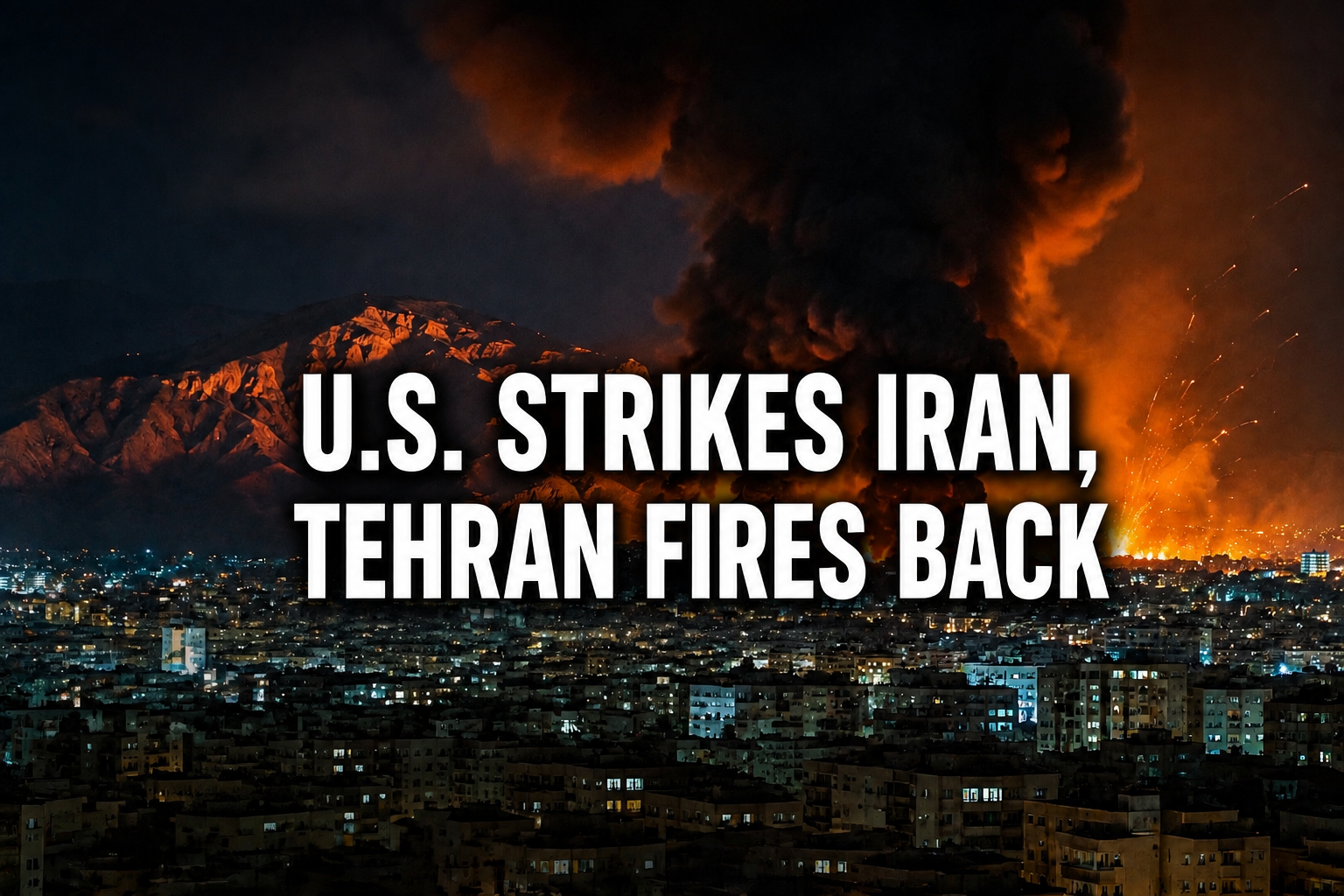
U.S. Strikes Iran as Tehran Fires Back, Raising Fears of a Wider Middle East Conflict
The United States launched a new round of military strikes against targets in Iran on Tuesday, September 1, 2026, triggering Iranian missile and drone retaliation and sharply escalating tensions around the strategically vital Strait of Hormuz.
The renewed confrontation comes after weeks of relative military calm and has immediately raised concerns about regional security, global energy supplies and the possibility of a broader conflict.
U.S. forces began striking targets linked to Iran’s Islamic Revolutionary Guard Corps at approximately noon Eastern Time on Tuesday. The U.S. military said the operation followed recent attempted attacks against commercial shipping in the Strait of Hormuz and threats against American service members deployed in the Middle East.
Explosions were subsequently reported in several areas of southern Iran, including locations around Bandar Abbas, Qeshm Island, Chabahar, Jask and Sirik.
Iran Responds With Missiles and Drones
Iran responded to the latest American attacks by launching missile and drone operations. Iranian military officials warned that further U.S. action would bring additional retaliation.
The latest strikes follow another confrontation over the weekend. U.S. forces had targeted Iranian rocket launchers on Larak Island, near the Strait of Hormuz, saying Iranian forces were preparing equipment capable of deploying naval mines.
Iran then launched ballistic missiles toward U.S. positions in Jordan. The missiles were intercepted, and U.S. officials reported no American casualties from that attack.
The rapid exchange of strikes has transformed what had been a period of relative calm into one of the most serious U.S.–Iran escalations in recent weeks.
President Donald Trump described the latest U.S. action as justified and warned Tehran that another Iranian response could trigger substantially stronger American military action.
Iran, meanwhile, has maintained a defiant position. Iranian officials have warned that pressure on the country’s oil exports could threaten energy shipments throughout the Persian Gulf.
Why the Strait of Hormuz Matters
At the center of the confrontation is the Strait of Hormuz, one of the most important energy corridors in the world.
The narrow waterway connects the Persian Gulf with the Gulf of Oman and the Arabian Sea. Under normal conditions, roughly one-fifth of the world’s oil supply passes through the strait, making any disruption there a major concern for international markets.
A prolonged military confrontation around the Strait of Hormuz could affect oil prices, gasoline costs, shipping routes and the broader global economy.
Oil markets have already reacted to the renewed fighting. Crude prices moved higher as traders assessed the possibility of additional attacks, shipping disruptions and tighter global energy supplies.
Civilian Casualties Raise New Concerns
The latest strikes have also brought reports of civilian casualties. Iranian officials said a residential property where a wedding was taking place in southern Iran was struck, resulting in deaths and dozens of injuries.
The circumstances surrounding the incident remain part of a rapidly developing situation, and information from the affected areas continues to emerge.
The fighting also increases risks for American military personnel and civilians throughout the Middle East. With U.S. forces stationed across the region, further Iranian retaliation could expand the geographic scope of the confrontation.
Diplomacy Faces a Critical Test
Despite the military escalation, diplomatic possibilities have not completely disappeared.
Iranian President Masoud Pezeshkian said earlier Tuesday that Iran remained prepared to return to commitments under an interim agreement if Washington also fulfilled its obligations.
However, the latest exchange of strikes makes renewed negotiations considerably more difficult.
The central question now is whether Washington and Tehran can contain the confrontation or whether each new retaliation will trigger another, potentially larger military response.
For global markets and governments across the Middle East, the next moves by both countries will be closely watched.
What began as another limited exchange around the Strait of Hormuz now carries consequences far beyond the immediate battlefield. Energy security, international shipping, U.S. military deployments and diplomatic efforts are increasingly tied to what happens next.
As of September 1, 2026, the situation remains fluid, with both the United States and Iran signaling that they are prepared to respond forcefully to further attacks.
Leave a Reply