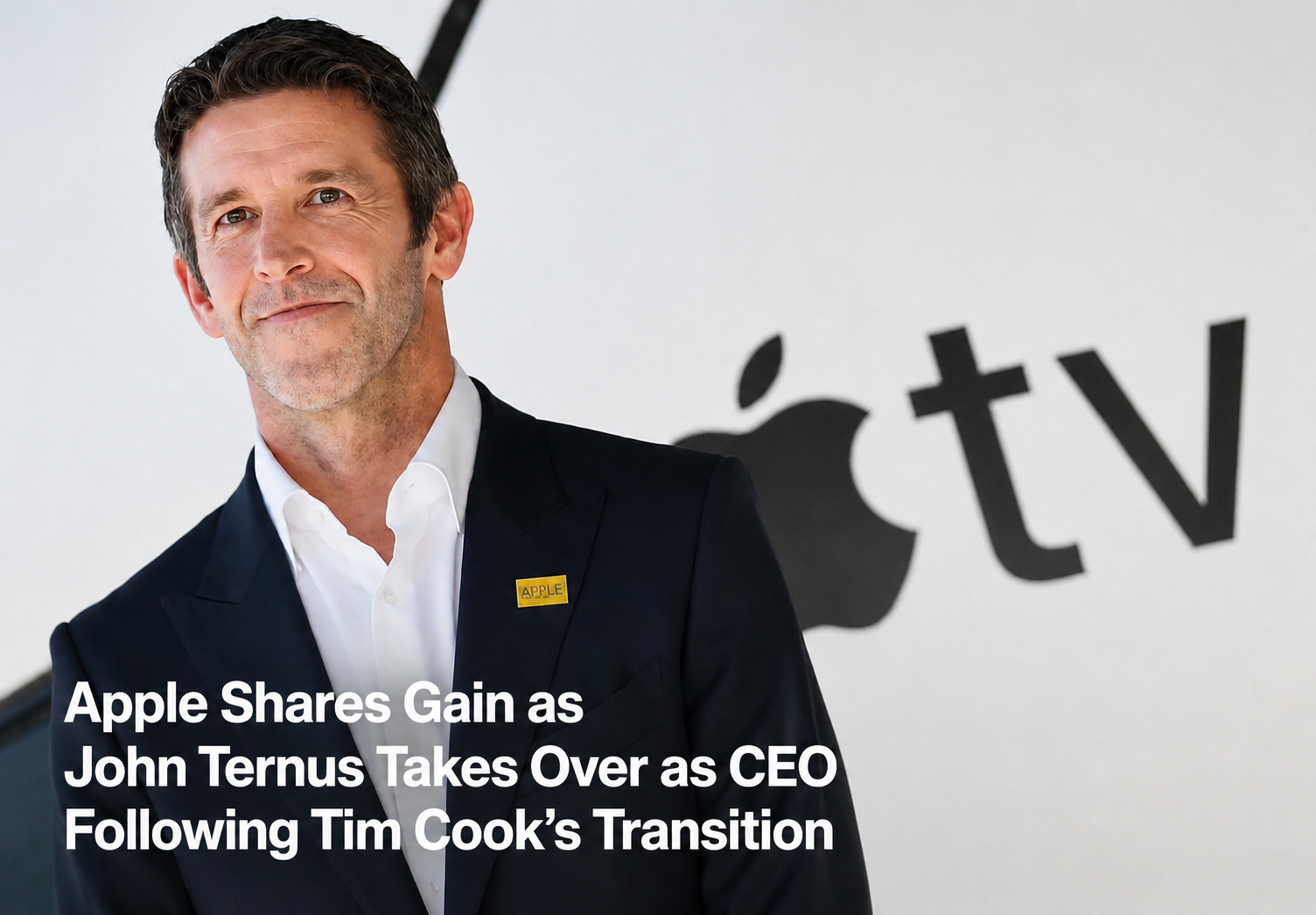
Apple Shares Gain as John Ternus Takes Over as CEO Following Tim Cook’s Transition
Apple entered a new chapter on September 1, 2026, as John Ternus officially became chief executive officer, succeeding Tim Cook after one of the most consequential leadership runs in modern corporate history. The closely planned transition has drawn significant attention from Wall Street, with Apple shares gaining in Tuesday trading as investors assess what the new leadership could mean for the technology giant’s next phase of growth.
Apple stock rose roughly 2.6% in morning trading, reaching as high as approximately $325.86 after closing the previous session at $316.85. The move was particularly notable as major U.S. stock indexes traded lower, suggesting that company-specific developments were helping support Apple shares.
The leadership transition marks Apple’s first CEO change in 15 years and places a longtime hardware executive at the center of the company’s strategy.
Ternus, 51, joined Apple’s Product Design organization in 2001 and steadily advanced through the company’s engineering leadership. He became vice president of Hardware Engineering in 2013 and later senior vice president, overseeing engineering for products including the iPhone, iPad, Mac and AirPods. He also played an important role in Apple’s transition from Intel processors to the company’s internally designed Apple silicon for Mac computers.
His engineering background could become increasingly important as Apple competes in a technology market being reshaped by artificial intelligence, custom chips and new device categories.
Tim Cook, meanwhile, is not leaving Apple. After approximately 15 years as CEO, Cook has transitioned to executive chairman of Apple’s board. In that position, he is expected to remain involved in selected areas of the company, including engagement with policymakers around the world.
The arrangement provides Apple with an unusual degree of leadership continuity. Ternus gains responsibility for running the company while retaining access to an executive who has spent more than a decade managing Apple’s global operations, supply chains and government relationships.
For investors, the combination of new product-focused leadership and Cook’s continued presence may reduce some of the uncertainty normally associated with a major CEO transition.
Cook leaves the CEO position with Apple dramatically larger than when he succeeded Steve Jobs in 2011. Apple’s market capitalization expanded from roughly $350 billion to more than $4.5 trillion during his tenure, while the company developed major businesses beyond its traditional Mac and iPhone franchises.
Apple Watch, AirPods and the company’s rapidly expanding services ecosystem became important parts of the business under Cook. Annual revenue reached approximately $416 billion in fiscal 2025, demonstrating the enormous scale Ternus now inherits.
Yet the new CEO also faces significant challenges.
Artificial intelligence is likely to remain one of the most closely watched areas. Apple has been working to strengthen its AI capabilities while competitors across the technology industry continue investing aggressively in generative and agentic AI. Investors will be watching whether Ternus can combine Apple’s hardware expertise, custom silicon and software ecosystem into a stronger AI strategy.
The central question for the Ternus era is whether Apple can translate its enormous installed base and engineering capabilities into the next major technology platform.
Product innovation will be another immediate test. Ternus built much of his career around hardware development, making his appointment particularly significant at a time when investors are looking for new product categories and meaningful upgrades capable of driving another growth cycle.
Apple’s upcoming September 9 product event will therefore receive exceptional attention. It will be Ternus’s first major product launch as CEO and could provide an early indication of how he intends to present Apple’s product strategy to customers and investors.
Wall Street sentiment remains mixed but constructive. Rosenblatt Securities raised its Apple price target to $303 from $300 while maintaining a neutral stance, reflecting continuing debate over the company’s valuation and the amount of future growth already reflected in its share price.
Other investors appear more focused on Apple’s long-term strengths: its global customer base, highly integrated hardware and software ecosystem, expanding services revenue, powerful brand and substantial financial resources.
The transition also comes after an extraordinary period for Apple shareholders. From the beginning of Cook’s tenure in August 2011 through the end of August 2026, Apple shares produced gains exceeding 2,000% on a split-adjusted basis.
That performance creates a demanding benchmark for Ternus.
Ternus does not simply inherit one of the world’s largest technology companies—he inherits expectations built during 15 years of extraordinary shareholder value creation.
His challenge will be balancing continuity with change. Apple must protect the businesses that made it enormously profitable while simultaneously investing in technologies that could define the next decade.
For now, the market’s positive reaction suggests investors are willing to give Apple’s new CEO an opportunity to demonstrate his strategy.
The Tim Cook era transformed Apple into a global financial and technological powerhouse. The John Ternus era begins with a different question: whether a leader shaped by Apple’s engineering culture can guide the company through AI, new computing platforms and the next generation of consumer technology.
With Apple shares gaining as the transition becomes official, Wall Street’s attention is now firmly focused on what comes next.
Leave a Reply