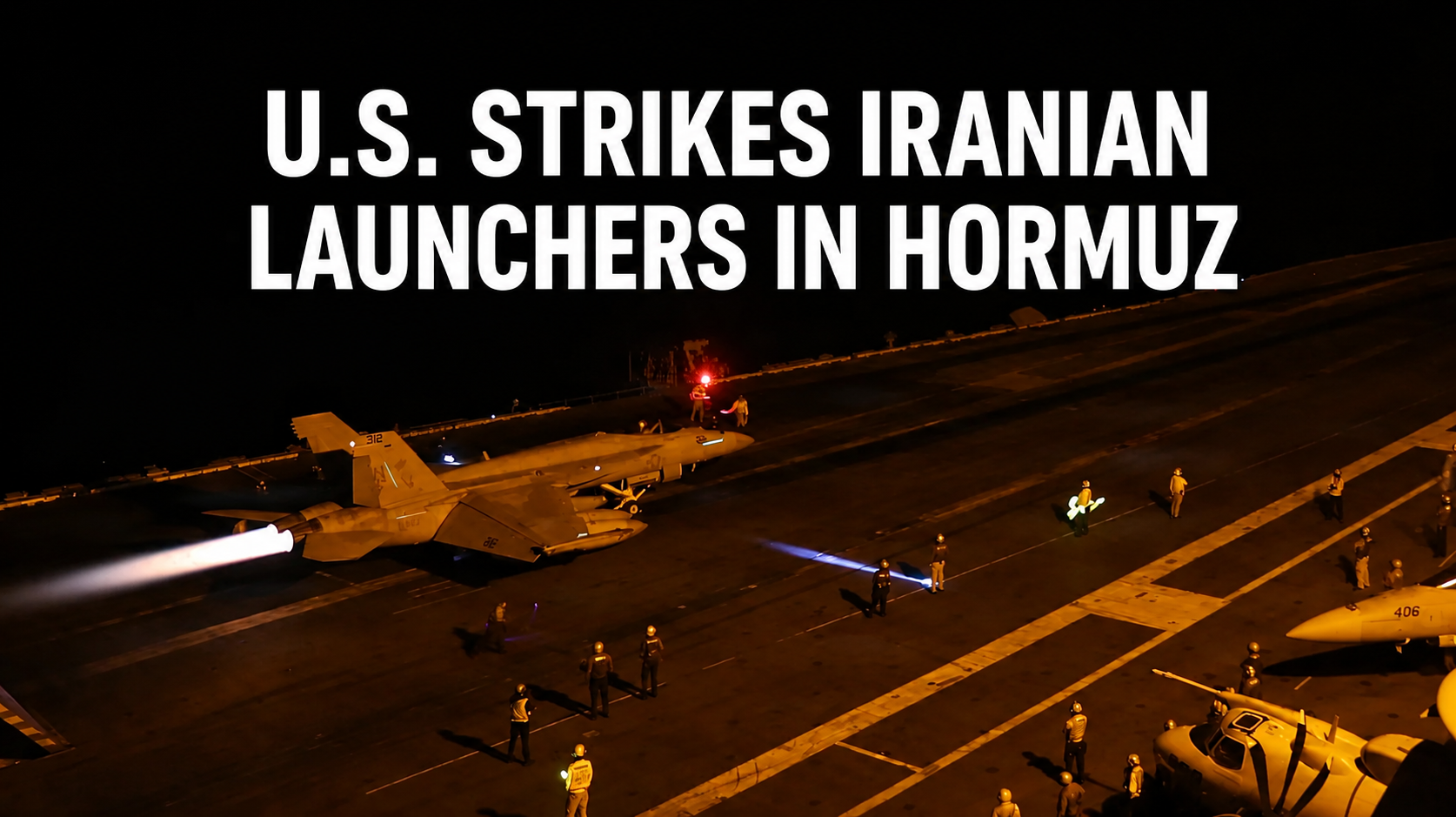
U.S. Military Strikes Iranian Rocket Launchers in Strait of Hormuz
The U.S. military has carried out new strikes against Iranian military positions near the Strait of Hormuz, marking a renewed escalation in tensions between Washington and Tehran after weeks of reduced direct military exchanges.
U.S. forces struck two Iranian rocket launchers on Larak Island, a strategically located Iranian island near the Strait of Hormuz. U.S. officials said Iranian forces were preparing military equipment that could threaten international shipping in one of the world’s most important maritime routes.
U.S. Targets Iranian Launchers on Larak Island
The strikes took place on August 30 as concerns increased over Iranian activity near the narrow waterway. According to U.S. officials, Iranian forces were preparing to deploy rockets and potentially naval mines in the area.
The United States described the operation as a defensive measure intended to protect shipping and American forces operating in the Gulf.
The Strait of Hormuz remains one of the most strategically important waterways in the global energy system, connecting major Persian Gulf oil producers with international markets.
Any significant disruption in the strait can quickly affect oil supplies, shipping costs and global energy prices.
Iran Responds With Missile Attacks
Following the U.S. strikes, Iran launched missiles toward U.S. military sites in Jordan. Jordanian defenses intercepted the incoming missiles, while the latest exchange raised concerns that the conflict could again intensify after a period of relatively limited direct military action.
The renewed confrontation represents the first major exchange of attacks between the United States and Iran in several weeks.
Iran has condemned U.S. military operations in the region and continues to argue that Washington must meet conditions connected to previous negotiations over navigation through the Strait of Hormuz.
Strait of Hormuz at Center of Global Attention
The latest military activity has once again placed the Strait of Hormuz at the center of international attention.
Shipping through the waterway has already faced significant disruptions during the broader U.S.-Iran conflict. Although maritime traffic has partially recovered, transportation levels remain below normal.
Oil markets reacted quickly to the renewed tension, reflecting concerns that additional military confrontations could disrupt energy shipments from the Persian Gulf.
A prolonged conflict around the Strait of Hormuz could have consequences far beyond the Middle East, potentially increasing transportation costs, energy prices and inflation pressures around the world.
Risk of Further Escalation Remains
President Donald Trump has warned that the United States could respond strongly to additional Iranian attacks. Meanwhile, Iranian officials have continued to signal that Tehran is prepared to defend its interests while also leaving open the possibility of diplomatic negotiations.
The situation remains highly fluid as both sides combine military pressure with economic and diplomatic strategies.
For global markets and governments, the central question is whether the latest U.S. strikes will remain a limited military operation or become the beginning of another larger confrontation.
With the Strait of Hormuz playing such a critical role in global energy transportation, even a limited military escalation between the United States and Iran could quickly produce worldwide economic consequences.
Leave a Reply