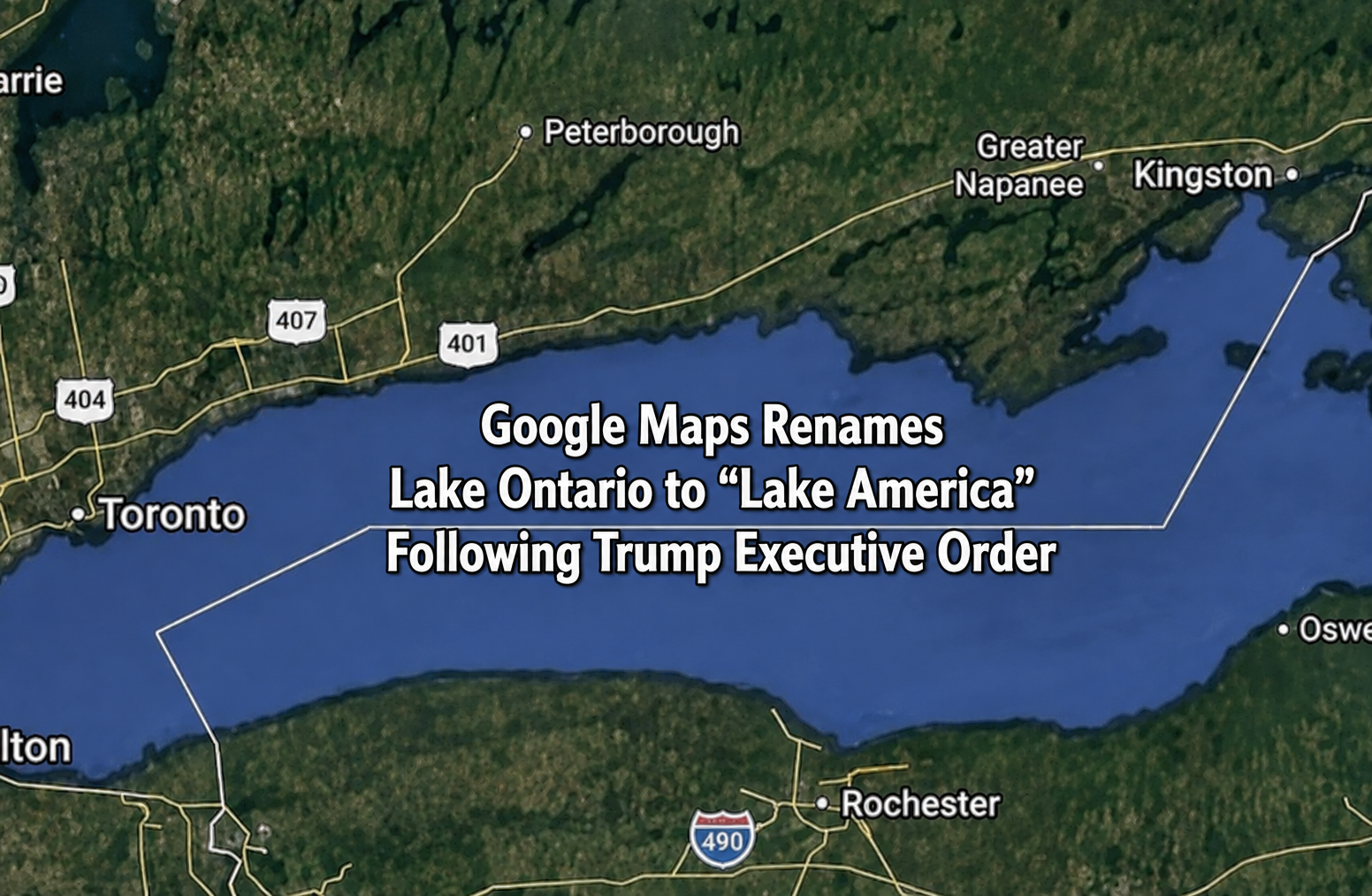
Google Maps Renames Lake Ontario to “Lake America” Following Trump Executive Order
Google Maps has begun displaying “Lake America” instead of “Lake Ontario” for users in the United States, following an executive order signed by President Donald Trump on August 27, 2026. The change has quickly become a major political and cultural story, drawing attention not only in the United States and Canada but also across the international technology and mapping industries.
The update means that the name users see on Google Maps now depends largely on where they are accessing the service. People located in the United States see Lake America, while users in Canada continue to see Lake Ontario. In many other countries, Google displays both names, generally showing “Lake Ontario (Lake America).”
The difference illustrates how digital maps increasingly reflect national naming policies rather than presenting a single universal label.
Trump’s Executive Order Changes U.S. Federal Naming
President Trump signed an executive order on August 27 directing the U.S. federal government to officially refer to Lake Ontario as Lake America.
The order instructs the Secretary of the Interior, working with the U.S. Board on Geographic Names, to update federal geographic databases and government references. The administration said the change recognizes the lake’s historical and economic importance to the United States.
Lake Ontario is one of North America’s five Great Lakes and forms part of the international boundary between the United States and Canada. New York borders the lake to the south and east, while the Canadian province of Ontario surrounds much of its northern and western shoreline.
The Trump administration highlighted American investment in Great Lakes infrastructure, environmental protection, shipping and security as part of its reasoning for adopting the new U.S. name.
Why Google Maps Changed the Name
Google has long maintained a policy of using official geographic naming information supplied by governments and authoritative geographic databases.
Following the federal action, the U.S. Geographic Names Information System was updated to reflect the name Lake America. Google subsequently adjusted Google Maps for American users.
The company’s regional approach is important.
The change does not mean that Lake Ontario has been universally renamed around the world.
Canada continues to officially recognize the body of water as Lake Ontario, and Canadian Google Maps users continue to see that traditional name.
For users outside the United States and Canada, Google may display both names to reflect the disagreement between national naming systems.
This approach is similar to the way Google handles other geographic locations where governments use different names for the same territory, body of water or landmark.
Canada Pushes Back Against “Lake America”
Canadian officials have strongly rejected the change.
Ontario Premier Doug Ford has publicly insisted that the lake will continue to be known as Lake Ontario in Canada. The controversy has also attracted criticism from political leaders in U.S. states bordering Canada.
The dispute goes beyond the name itself.
Lake Ontario has centuries of historical, cultural and economic significance for communities on both sides of the border. It is also closely connected with Indigenous history and the development of both Canada and the United States.
Because the lake is shared internationally, a decision by one country does not automatically determine what another country must call it.
Google Maps Update Creates Unexpected Effects in Canada
The Google Maps change has also produced some unusual technical consequences.
Although Canadian users normally see Lake Ontario, several Canadian websites and digital services that rely on U.S.-based Google mapping technology reportedly began displaying Lake America.
Organizations affected by the mapping change have been reviewing how third-party map systems determine geographic labels.
The situation demonstrates how a seemingly simple change to a geographic database can quickly spread across websites, transportation tools, business applications and other services that depend on external mapping platforms.
Apple Maps Faces Pressure to Follow Google
Attention has now turned to Apple Maps.
U.S. Interior Secretary Doug Burgum said President Trump had personally contacted Apple regarding the Lake America designation. As of August 31, Google Maps has already implemented the change for U.S. users, while Apple’s response has been closely watched.
If Apple adopts the new federal designation, two of the world’s largest consumer mapping platforms could show Lake America to American users.
Other mapping companies, however, are taking different approaches.
MapQuest has continued using Lake Ontario, and the company has received significant attention for refusing to adopt the new name. Its app reportedly experienced a sharp increase in downloads following the controversy.
The competing decisions show that digital mapping companies are becoming active participants in disputes involving geography, politics and national identity.
The Change Follows the “Gulf of America” Decision
The Lake America order follows another prominent geographic renaming initiative from the Trump administration.
In January 2025, Trump ordered the U.S. government to use Gulf of America instead of Gulf of Mexico for federal purposes.
Google Maps later adopted Gulf of America for users in the United States while maintaining different naming conventions in other regions.
The Lake Ontario decision follows a similar model: U.S. federal terminology changes first, followed by updates from technology companies that rely on U.S. government geographic databases.
What the Lake America Name Actually Means
The most important distinction is that Lake America is currently a U.S. federal designation, not a universally recognized international replacement for Lake Ontario.
For practical purposes, Americans using Google Maps may increasingly encounter the new name.
Canadians will continue seeing and using Lake Ontario.
International users may encounter both.
Government documents, school materials, media organizations, navigation systems and international institutions may also make different choices depending on their location and naming standards.
That means the two names could coexist for an extended period.
A Geographic Name Becomes a Global Political Story
What began as an executive order has rapidly expanded into a much larger debate about national identity, international relations and the power of technology companies.
Google Maps is used by billions of people to navigate and understand the physical world. When a major platform changes a geographic name, that decision can influence how millions of users perceive a location almost immediately.
The Lake America controversy therefore represents more than a change on a digital map.
It highlights the growing connection between government policy, technology platforms and the way geographic information is presented to the public.
As of August 31, 2026, one thing is clear: Americans opening Google Maps may now see Lake America, Canadians continue to see Lake Ontario, and the disagreement over what one of North America’s Great Lakes should be called is unlikely to disappear anytime soon.
Leave a Reply