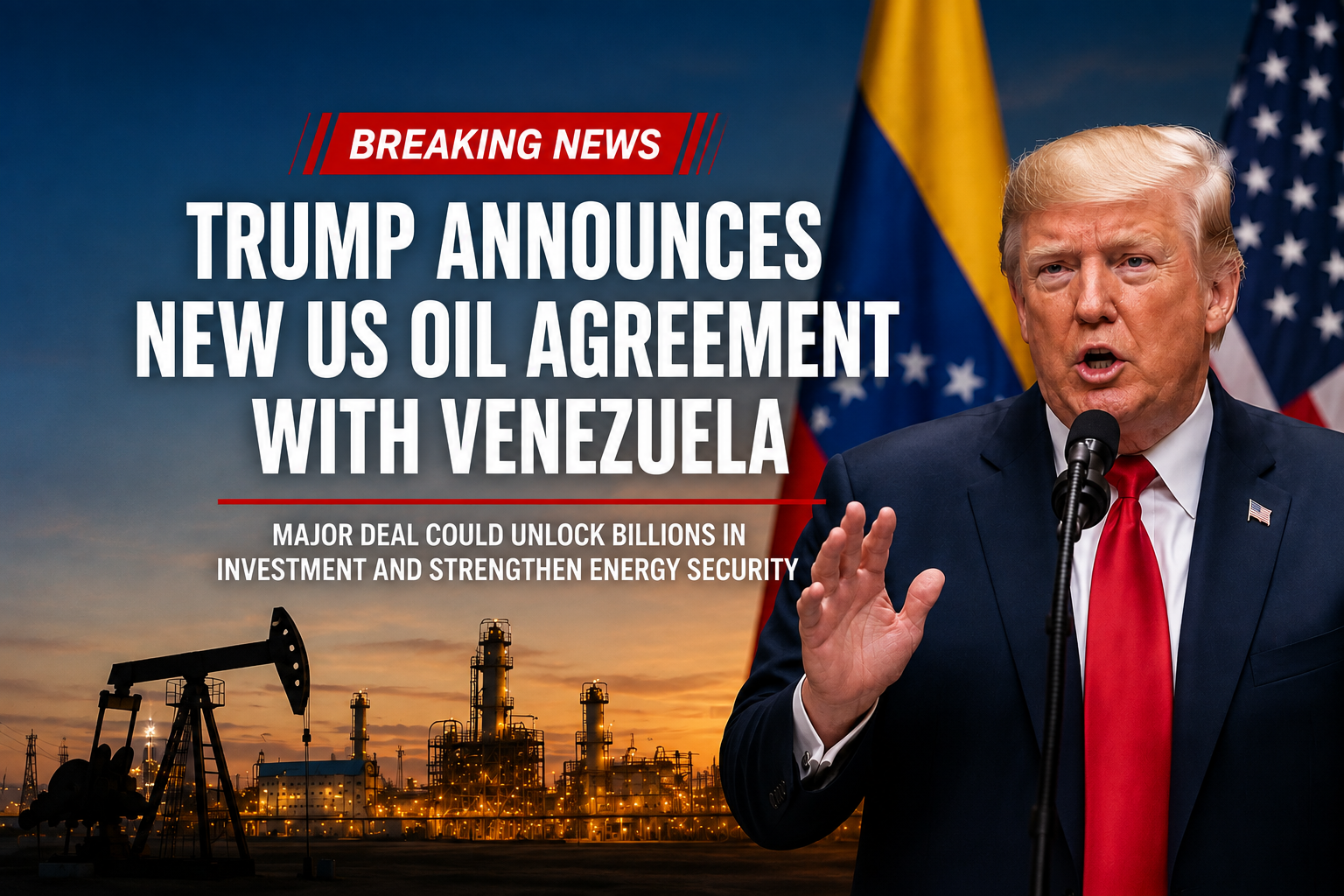
WASHINGTON — President Donald Trump has announced a major new oil agreement with Venezuela, potentially opening a new chapter in relations between Washington and Caracas while reshaping the energy landscape across the Western Hemisphere.
The agreement centers on expanding U.S. involvement in Venezuela’s enormous petroleum sector. Venezuela holds the world’s largest proven crude oil reserves, estimated at more than 300 billion barrels, but years of underinvestment, sanctions, political instability and deteriorating infrastructure have kept production far below its historic levels.
The announcement could therefore have consequences extending well beyond the two countries. Energy markets, American refiners, international oil companies and consumers are likely to watch closely as details of the agreement emerge.
U.S. Eyes Greater Access to Venezuela’s Vast Oil Resources
At the heart of the agreement is increased American participation in Venezuela’s oil industry.
Venezuela’s massive reserves have long made the country strategically important to the global energy market. Much of its crude is heavy oil, which certain U.S. Gulf Coast refineries are specifically equipped to process.
Greater access to Venezuelan production could potentially provide American refiners with another significant source of crude while reducing reliance on supplies transported across longer and potentially less stable international routes.
However, possessing enormous reserves does not automatically translate into immediate production.
Venezuela’s oil industry requires substantial investment in drilling operations, pipelines, power infrastructure, transportation systems and production facilities. Restoring output to significantly higher levels could require years and tens of billions of dollars in investment.
Billions in Investment Could Follow
A successful agreement could encourage major U.S. and international energy companies to increase investment in Venezuela.
Modernizing the country’s aging petroleum infrastructure would be one of the most important steps toward increasing production.
New capital could potentially restore inactive wells, repair pipelines, improve export terminals and introduce modern technology into fields that have suffered from years of insufficient investment.
For Venezuela, the economic stakes are enormous.
Oil has historically provided a large share of the country’s export earnings and government revenue. A sustained recovery in petroleum production could generate additional income, attract foreign capital and potentially create thousands of jobs throughout the energy industry and related sectors.
For American companies, meanwhile, Venezuela represents access to one of the largest concentrations of petroleum resources anywhere in the world.
Could the Deal Affect U.S. Gas Prices?
For American consumers, one of the most important questions is whether increased Venezuelan production could eventually help lower gasoline prices.
In theory, bringing additional crude oil onto international markets increases global supply. If production rises substantially while demand remains relatively stable, additional supply can place downward pressure on crude prices.
That could eventually influence gasoline, diesel and other petroleum-product prices.
But any effect is unlikely to be immediate.
Gasoline prices are determined by a complicated combination of global crude prices, refinery capacity, transportation costs, seasonal demand, inventories, geopolitical developments and production decisions by major oil-producing nations.
Venezuela would also need significant time and investment before dramatically increasing its output.
The agreement should therefore be viewed primarily as a long-term energy strategy rather than a guarantee of immediate relief at American gas stations.
Venezuela’s Oil Industry Faces Major Challenges
Despite its extraordinary petroleum wealth, Venezuela faces serious obstacles.
Much of the country’s oil infrastructure has deteriorated after years of economic difficulties and limited investment. Production facilities require modernization, while some pipelines, refineries and electrical systems need extensive repairs.
Heavy Venezuelan crude can also be more technically difficult and expensive to produce and process than lighter varieties of petroleum.
Political and legal uncertainty presents another challenge.
Foreign companies considering multibillion-dollar investments generally seek long-term guarantees regarding contracts, taxes, ownership rights and political stability.
Without those assurances, attracting the enormous amount of capital required to rebuild Venezuela’s petroleum sector could prove difficult.
A Significant Geopolitical Development
The agreement carries geopolitical implications far beyond energy production.
Venezuela has maintained significant economic relationships with countries including China and Russia. Greater American participation in Venezuela’s petroleum sector could shift some of those relationships and strengthen Washington’s economic influence in Latin America.
Geography also gives Venezuelan oil strategic value for the United States.
Compared with petroleum transported from the Middle East or other distant producing regions, Venezuelan crude can reach U.S. Gulf Coast refineries through relatively short maritime routes.
That proximity could become increasingly important as governments and companies seek more resilient energy supply chains.
Questions Over Control, Investment and Sovereignty
Despite the significance of Trump’s announcement, important questions remain about exactly how the agreement will operate.
The structure of U.S. participation, the companies involved, investment requirements, revenue distribution and regulatory framework will all be critical to determining the agreement’s ultimate impact.
The issue of Venezuelan sovereignty could also become politically sensitive.
Oil is Venezuela’s most important natural resource, and any arrangement providing foreign entities with extensive influence over petroleum production is likely to face intense political scrutiny.
The final legal structure of the agreement may therefore be just as important as its economic ambitions.
What Happens Next?
Investors and energy markets will now focus on implementation.
The most important indicators will include new contracts with energy companies, investment commitments, changes in Venezuelan production levels and increases in crude exports.
If significant investment materializes and production rises, Venezuela could gradually regain a larger role in the international petroleum market.
American refiners could benefit from greater access to heavy crude, while Venezuela could receive desperately needed capital for rebuilding its energy infrastructure.
But transforming vast underground reserves into reliable commercial production will require time, money and political stability.
A Potential Turning Point for Global Oil Markets
Trump’s announcement represents a potentially important shift in U.S. energy policy toward Venezuela.
For the United States, greater access to Venezuelan oil could strengthen energy security, diversify crude supplies and increase American influence over a strategically important petroleum-producing country.
For Venezuela, renewed investment could provide an opportunity to rebuild an industry that remains central to its economy.
The ultimate significance of the agreement, however, will depend on implementation.
If investment flows and Venezuelan production expands substantially, the effects could eventually reach global oil markets and American consumers alike.
For now, the U.S.-Venezuela oil agreement marks the beginning of what could become one of the most closely watched energy developments of 2026.
Leave a Reply